
Why Choose Us: Sourced Dog Treats You Can Trust

Table of Contents
Why Sourced Dog Treats Beat Mass-Produced Snacks
Natural Dog Treats Without Artificial Additives: What to Look For
Benefits of Single-Ingredient Dog Treats for Sensitive Dogs
How to Read Dog Treat Labels Like a Pro
Supply Chain Transparency: How We Verify Every Batch
Pathogen Risks in Imported Ingredients vs. Domestic Sourcing
Environmental Footprint: Local Sourcing vs. Overseas Shipping
What Makes Five Local Dogs Different
Conclusion: Choosing Sourced Dog Treats with Confidence
Frequently Asked Questions
Last Updated: September 16, 2026
Why Sourced Dog Treats Beat Mass-Produced Snacks
Walk down any pet store aisle and you'll see bags with cartoon chickens, glossy photos, and ingredient lists that read more like a chemistry set than food. That's the trade-off mass production asks you to accept. Sourced dog treats, by contrast, start with a short list of ingredients a person can actually pronounce and trace back to a farm. At Five Local Dogs, we built our whole approach around that idea: one ingredient, sliced by hand, dehydrated in small batches, with nothing added to stretch shelf life or improve appearance.
The difference shows up in the details. Mass-produced snacks often rely on fillers, artificial preservatives, and coatings to survive months of shipping and storage. A single-ingredient treat skips all of that. What you're buying is the ingredient itself, prepared carefully, not a manufactured product engineered around it.
Below, we'll walk through what to look for on a label, why sourcing matters, and how to tell the difference between marketing language and real transparency.
Natural Dog Treats Without Artificial Additives: What to Look For
Natural dog treats without artificial additives are treats whose ingredient list contains only recognizable food, with no synthetic preservatives, colors, or flavorings added. The simplest test is to read the panel and ask whether every item is something you'd recognize in a kitchen.
A few things to check:
Ingredient count. One or two items is a strong signal. Long lists usually mean fillers or stabilizers.
Preservative names. Watch for BHA, BHT, ethoxyquin, and propylene glycol. These exist to extend shelf life, not to nourish your dog.
Coating claims. Terms like "flavor-coated" or "glazed" often hide added sugars, syrups, or artificial flavoring.
Country of origin. If the label doesn't say where the protein came from, that's a gap worth questioning.
The FDA's guidance on pet food labeling explains which parts of a label are regulated and which are marketing language, and it's worth reading before your next shopping trip. A treat that lists "chicken" and nothing else is telling you something a treat with twelve ingredients is trying to hide.
Pro Tip Flip the bag over before you look at the front. The ingredient panel and the guaranteed analysis tell you more in ten seconds than any photo of a happy dog on the packaging ever will.
Benefits of Single-Ingredient Dog Treats for Sensitive Dogs
For dogs with food sensitivities, single-ingredient treats remove the guesswork. When a treat contains only dehydrated chicken, there's exactly one thing to evaluate if your dog reacts. Multi-ingredient snacks make that detective work nearly impossible.
This matters most for dogs on limited-ingredient diets, often recommended by veterinarians when a food allergy or chronic digestive issue is suspected. A treat with a single protein source fits cleanly into that plan. A treat with chicken, wheat, corn, and three preservatives does not.
Digestive health and coat quality are the two areas owners tend to notice first. Dogs with sensitive stomachs often do better on simpler proteins because there's less for the gut to process. Coat condition tends to reflect overall nutrition, so removing fillers and additives can show up as a shinier coat over time.
Picky eaters benefit too, for a different reason. Dehydrated meat carries a concentrated aroma that plain kibble doesn't. Many dogs that reject processed biscuits will accept a piece of real dehydrated protein without hesitation.
How to Read Dog Treat Labels Like a Pro
Reading a dog treat label well comes down to knowing which sections carry legal weight and which are there to sell. The ingredient list, the guaranteed analysis, and the manufacturer contact information are the parts that matter.
Here's a quick reference for what each label element actually tells you:
Label Element | What It Tells You | What to Watch For |
Ingredient list | Every item in the product, by weight | Long lists, unnamed "meat meal," added sugars |
Guaranteed analysis | Minimum protein/fat, maximum fiber/moisture | Doesn't list preservatives or additives |
"Natural" claim | Loosely defined by regulators | Not the same as "no preservatives" |
Country of origin | Where ingredients were sourced | Missing or vague origin statements |
Manufacturer info | Who made it and where to ask questions | No contact details is a red flag |
The word "natural" deserves special attention. It does not automatically mean preservative-free. A treat can be labeled natural and still contain synthetic preservatives, because the term applies to the ingredients, not the additives.
Watch Out Don't assume "premium" or "gourmet" on the front of a bag means anything regulated. Those words are marketing, not standards. The ingredient panel is the only part that has to follow labeling rules.
Supply Chain Transparency: How We Verify Every Batch
Supply chain transparency means knowing where every raw material came from and being able to prove it with documentation, not just saying so on a bag. Most guides stop at that definition. The useful part is the how: what records exist, who checks them, and what a pet parent can actually request.
For us, verification starts before the chicken reaches our kitchen. Every batch is sourced from farms in the United States, and each one is tied to a lot number that follows the meat from receiving through slicing, dehydration, and packing. If a question comes up about a specific bag, that number is what lets us walk the batch back to its source.
Here's the documentation chain a producer should be able to produce on request:
Supplier identification. The name and location of the farm or processor, not a vague region or a broker.
Lot or batch codes. A unique identifier that links a finished bag to a specific production run and its raw material.
Receiving records. Dates, quantities, and condition notes logged when raw material arrives.
Production logs. Who ran the batch, when, at what temperature, and for how long.
Third-party verification. Independent audits or laboratory testing, where applicable, with the results on file rather than summarized in marketing copy.
A certificate of analysis, or COA, is one of the clearest signals to ask about. A COA is a lab report tied to a specific lot that documents what was tested and what the results were. Not every producer runs one for every batch, and testing scope varies, but a company that can produce a COA on request is demonstrating a level of record-keeping that a company relying on verbal assurances is not.
Third-party audits work differently. An audit reviews a producer's processes and records against a standard, conducted by an outside party rather than the company itself. The value is independence: a self-reported claim and a verified one are not the same thing. When you're evaluating a brand, it's fair to ask whether any part of their process is checked by someone outside the company.
For pet parents, the practical test is simple: ask for the documentation. A producer who genuinely controls their supply chain will have lot codes, receiving records, and a clear answer about testing. One who doesn't will pivot to storytelling. The claim on the front of the bag costs nothing to print. The paper trail behind it is what separates a real sourcing commitment from decoration.
Key Takeaway You don't need to read every record yourself. You need to know the producer keeps them and will share them. Ask for a lot code and what it traces back to. The quality of the answer tells you most of what you need to know.
This is also where domestic sourcing earns its keep. A shorter, more controlled chain is easier to document end to end. When raw material passes through multiple countries and intermediaries, the records get thinner at every handoff, and the ability to trace a finished product back to a single farm gets harder to guarantee.
Pathogen Risks in Imported Ingredients vs. Domestic Sourcing
Imported ingredients carry a different risk profile than domestically sourced ones, and the reason is structural rather than a matter of any single country's standards. More handling steps, longer transit, and less consistent oversight all widen the window in which contamination can occur.
The pathogens that matter most in raw or minimally processed protein are well documented. Salmonella is the most common concern in poultry and is the organism behind many pet food and treat recalls. Listeria monocytogenes is a particular worry because it tolerates cold temperatures, meaning refrigeration does not stop it the way it stops many other bacteria. E. coli strains, including Shiga toxin-producing types, appear in contaminated raw materials and have been linked to pet food recalls. These are not exotic risks; they are the routine contaminants that food safety systems are built to manage.
Understanding how contamination enters the chain explains why sourcing distance matters. Pathogens can be present on raw poultry at the farm, and every subsequent step, processing, packing, shipping, repacking, storage, is a point where cross-contamination can occur or where temperature control can fail. A domestic supply chain with a handful of handoffs has fewer of those points than an imported one that passes through exporters, freight consolidators, importers, and distributors before it reaches a kitchen.
Regulatory oversight differs in kind, not just degree. The USDA's Food Safety and Inspection Service inspects meat and poultry produced domestically under a continuous inspection system, which gives buyers a known standard to point to. Imported meat and poultry must meet equivalent requirements to enter the country, but verifying that equivalence across many suppliers and origin countries is a broader task than inspecting a domestic plant, and the practical oversight a buyer can rely on is correspondingly less direct.
Processing method changes the risk equation too. Dehydration removes moisture, and moisture is what bacteria need to multiply. A properly dehydrated treat is more stable than a raw or semi-moist product because the environment no longer supports rapid growth. That is a meaningful advantage, but it is not a substitute for clean sourcing. Dehydration reduces risk; it does not sterilize a contaminated ingredient.
Some households should treat this more carefully than others. The CDC's guidance on pets and food safety notes that young children, older adults, and immunocompromised people are more vulnerable to infections that can be transmitted from pet food and treats. For those households, handling treats the way you handle your own raw food, washing hands after contact, keeping surfaces clean, storing properly, is a reasonable precaution regardless of where the product was sourced.
Watch Out "Made in the USA" and "sourced in the USA" are not the same claim. A product can be assembled domestically from imported ingredients. If origin matters to you, look for language that speaks to where the protein itself came from, not just where the bag was filled.
The takeaway is not that imported ingredients are inherently unsafe. It is that a shorter, more closely overseen supply chain gives you fewer unknowns to manage, and for a product you feed your dog every day, fewer unknowns is the point.
Environmental Footprint: Local Sourcing vs. Overseas Shipping
Local sourcing reduces the environmental footprint of a treat in ways that are easy to overlook. Shipping protein across an ocean requires refrigeration, packaging, and fuel, all of which add up across a supply chain.
Shorter distances mean less cold-chain infrastructure, less packaging designed to survive weeks in transit, and less spoilage along the way. For a product like dehydrated chicken, where the whole point is a clean, simple ingredient, a shorter journey from farm to kitchen keeps it closer to what it was.
There's an economic angle too. Buying from domestic farms keeps money circulating in local agricultural communities rather than routing it through international intermediaries. For small producers, that relationship often means better visibility into how the animals were raised and handled.
Sustainability claims are easy to make and hard to verify. The ones that hold up tend to be specific: named regions, documented suppliers, shorter transit routes. Vague statements about being "eco-friendly" without any of that detail are worth treating with skepticism.
What Makes Five Local Dogs Different

Five Local Dogs exists because we wanted something better for our own dogs. That's the honest origin story. We were tired of reading labels full of things we didn't recognize and wanted a treat we could feel good about feeding every day.
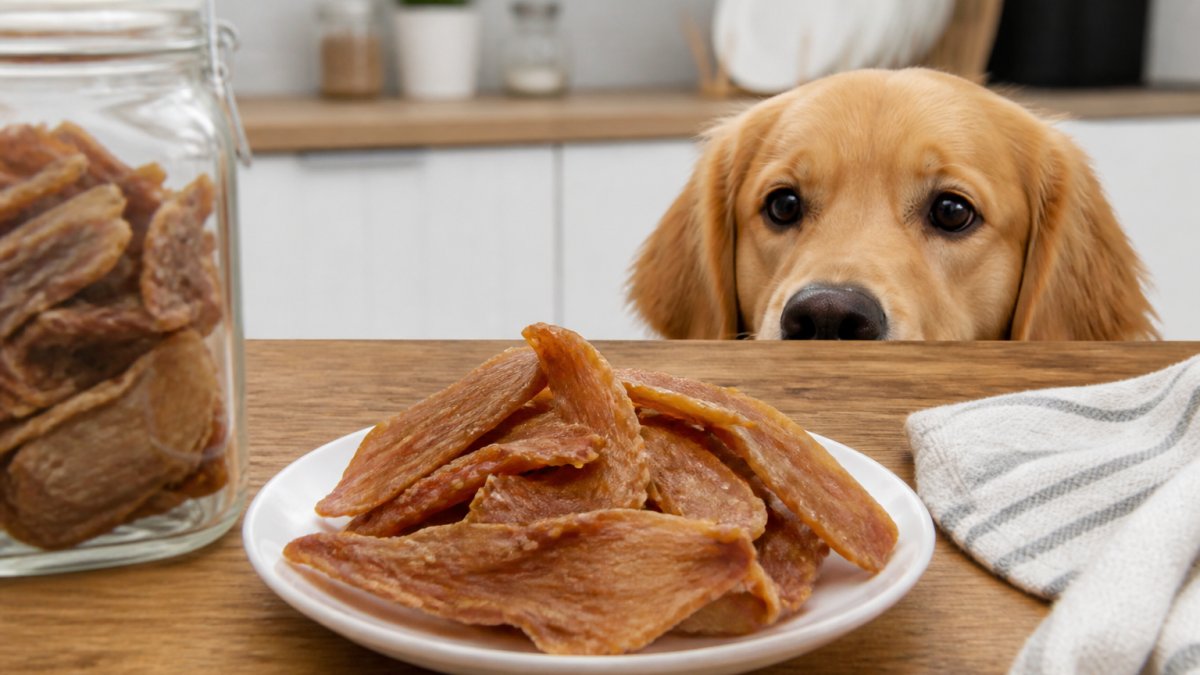
What we make is straightforward: single-ingredient dehydrated chicken treats, hand-sliced, produced in small batches, with no preservatives and no artificial coatings. Every batch is sourced from farms in the United States. Small-batch production is slower, but it's how we keep consistency high and quality visible from one bag to the next.
We're not trying to be the biggest name in pet treats. We're trying to be the one you trust because you can see exactly what's in the bag and where it came from. If you've got a picky dog or one with a sensitive stomach, that simplicity is often the whole point.
Conclusion: Choosing Sourced Dog Treats with Confidence
The pet treat aisle is designed to overwhelm you with options, most of them louder than they are informative. Cutting through that comes down to a few habits: read the ingredient panel first, question vague origin claims, and favor producers who can actually document where their ingredients come from. None of that requires expertise, just a willingness to flip the bag over.
If you want a treat that skips the guesswork entirely, Five Local Dogs makes single-ingredient dehydrated chicken treats with no preservatives, no coatings, and chicken sourced from U.S. farms. Every batch is hand-sliced and produced in small batches for consistency you can taste and smell. Visit the shop to see current availability and find the right size for your dog.
Frequently Asked Questions
How can I verify that dog treats are actually sourced from domestic suppliers?
Look for brands that share supplier relationships openly and provide documentation like Certificates of Analysis or USDA inspection records. Ask specific questions: Which farms supply the chicken? Where is the product manufactured? Reputable brands answer without hesitation. Third-party testing results and transparent labeling that names the source region are strong indicators. If a company cannot tell you where their raw materials come from, that is a red flag for sourced dog treats.
What ingredients should I avoid in store-bought dog treats?
Avoid artificial preservatives like BHA, BHT, and ethoxyquin, along with synthetic colors, added sugars, and propylene glycol. Watch for vague terms like 'meat meal' or 'animal by-products' that do not specify the source. Fillers such as corn syrup, wheat gluten, and cellulose add bulk without nutrition. For dogs with sensitivities, skip treats with multiple protein sources or long ingredient lists. Single-ingredient options eliminate guesswork about what is actually in the bag.
Why is single-ingredient sourcing better for dogs with sensitive stomachs?
When a treat contains one ingredient, identifying a trigger for digestive upset becomes straightforward. Dogs with food allergies or sensitivities react to specific proteins, grains, or additives, and multi-ingredient treats make isolating the culprit nearly impossible. Single-ingredient treats also reduce the risk of cross-contamination during manufacturing. For pet parents managing limited-ingredient diets, these treats provide a safe option that supports digestive health without introducing unknown variables.
What does 'human-grade' mean when applied to dog treats?
Human-grade means every ingredient and the finished product meet federal standards for human consumption, including being processed in a facility licensed for human food production. This is stricter than 'feed-grade,' which allows ingredients unfit for people. However, human-grade is not a regulated term on pet food labels, so verify the claim by checking whether the manufacturer holds the appropriate USDA or FDA facility registrations. Ask for documentation rather than trusting the phrase alone.
SHOP

Comments