
How to Transition Dog to Natural Treats: 2026 Guide

Table of Contents
Why Transition Your Dog to Natural Treats
What You'll Need Before You Start
Step 1: Choose the Best Treats for Dogs with Allergies
Step 2: Build a Dog Treat Transition Schedule
Adjust the Schedule for Your Dog's Profile
What to Do When a Step Fails
Tie the Schedule to Treat Calories, Not Treat Count
Step 3: Mix Old and New Treats Gradually
Step 4: Watch for Signs of Food Sensitivity in Dogs
Step 5: Adjust Portions and Daily Limits
Troubleshooting Picky Eaters and Setbacks
Diagnose the Refusal Before You Fix It
The Escalation Ladder
The Three-Strike Rule
When the Dog Is Kibble-Addicted
Setbacks That Aren't About the Treat
Common Mistakes to Avoid
Frequently Asked Questions
Last Updated: September 26, 2026
Why Transition Your Dog to Natural Treats
Switching your dog to natural treats is one of the simplest upgrades you can make to their daily routine. It matters because treats often make up a real share of a dog's daily calories, and many mass-produced snacks hide fillers, artificial coatings, and preservatives behind clever packaging. This guide from Five Local Dogs walks you through how to transition dog to natural treats step by step, without upsetting your dog's stomach or your budget.
The core idea is simple: natural treats are snacks made from whole ingredients, with little to nothing added. A single-ingredient dehydrated chicken treat, for example, is just chicken. That short ingredient list is exactly what makes these treats easier on sensitive stomachs and easier to trust.
Below, we'll show you exactly how to move from old treats to new ones over a set schedule. We'll also cover what to do when your dog turns their nose up, and the mistakes that trip most owners up.
What You'll Need Before You Start
Get your basics ready before the first treat changes hands. A little prep now prevents a messy week later.
Here's your starter kit:
A small bag of your dog's current treats
One bag of the new natural treats
A kitchen scale or measuring scoop
A notebook or phone note for tracking
A quiet spot for feeding
Your vet's number, just in case
Weigh your dog's current treat portion first. Most owners guess, and guesses run high. Knowing the real number makes the switch smoother.
Pro Tip Start the transition on a calm week. Skip it during travel, vet visits, or big schedule changes. Stress and diet changes stacked together make it hard to tell what caused a loose stool.
Step 1: Choose the Best Treats for Dogs with Allergies
The best treats for dogs with allergies are single-ingredient or limited-ingredient options. Fewer ingredients mean fewer chances of hitting a trigger. If your dog has a diagnosed allergy, ask your vet to confirm the protein is safe before you buy.
Read the label like a detective. You want one thing on it, not fifteen.
Single protein: chicken, turkey, or another protein your dog already tolerates
No artificial preservatives: skip BHA, BHT, and ethoxyquin
No fillers: no corn, wheat, or soy
No coatings: nothing dyed, glazed, or flavored
Clear sourcing: the label should say where the meat comes from
For dogs with sensitive stomachs, a plain dehydrated chicken treat is a smart first pick. It's easy to digest and easy to break into small pieces.
If you're unsure which protein to try, ask your vet about an elimination diet approach. That's the standard way to pin down a food intolerance.
Step 2: Build a Dog Treat Transition Schedule
A dog treat transition schedule spreads the change over 7 to 10 days. Slow beats fast here. Your dog's digestive system needs time to adjust to any new food, even a gentle one.
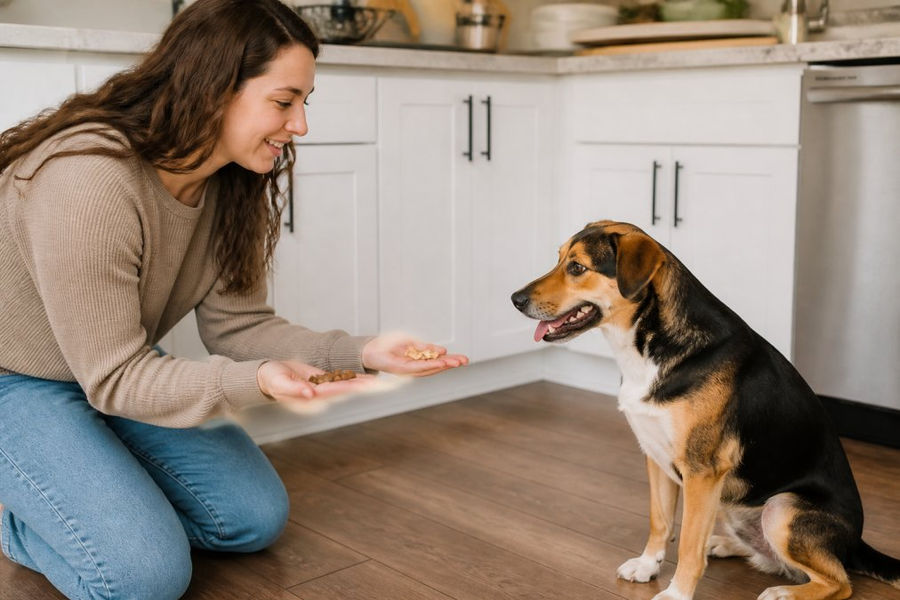
The schedule below is the baseline for a healthy adult dog with no known food sensitivities. It assumes you're replacing treats only, not the main meal.
Day | Old Treats | New Natural Treats | What to Watch |
1 | 100% | 0% | Baseline stool. Log it. |
2-3 | 75% | 25% | One new piece per three old pieces |
4-5 | 50% | 50% | Stool firmness, gas, appetite |
6-7 | 25% | 75% | Energy level, coat, paw licking |
8-9 | 10% | 90% | Confirm no delayed reactions |
10 | 0% | 100% | Full switch |
Break each treat into pea-sized pieces. Small pieces mean you can reward more often without overfeeding. A pea-sized piece of dehydrated meat is roughly the size of a pencil eraser, that's your visual reference.
Adjust the Schedule for Your Dog's Profile
One timeline does not fit every dog. Use these modifiers:
Sensitive stomach or prior food reaction: stretch to 14-21 days. Hold each ratio for 3-4 days instead of 2.
Senior dogs (7+ years): add 3-5 days. Digestive enzyme activity and gut motility slow with age, so the same food change hits harder.
Puppies under 6 months: keep the 10-day frame but halve the treat size. Puppies have smaller stomachs and a lower calorie ceiling, so portion discipline matters more than speed.
Dogs on a prescription diet: do not start without your vet's sign-off. Even a treat can disrupt a therapeutic plan.
Dogs with a history of pancreatitis or IBD: treat any new protein as a trial. One new protein at a time, minimum 2 weeks apart.
What to Do When a Step Fails
If you see loose stool, vomiting, or a sudden refusal to eat at any stage, don't push forward. Drop back one full step and hold there for 3-4 days. If the stool normalizes, resume the climb. If it doesn't within 48 hours, stop the new treat and call your vet.
Tie the Schedule to Treat Calories, Not Treat Count
A schedule that ignores calories is a schedule that quietly adds weight. Before day 1, weigh your dog's normal daily treat portion. If your dog gets 6 biscuits a day and each biscuit is about 30 calories, that's roughly 180 treat calories. Your new dehydrated chicken pieces may run closer to 15-20 calories per pea-sized piece, so the same count delivers far fewer calories, which is fine, but it means you can't swap one-for-one by number and expect the same satiety or training value.
Weigh the day's treats. Write the number down. Adjust the count so the daily calorie total stays roughly the same through the transition, then dial it down once you're on 100% new treats if your dog is carrying extra weight.
Step 3: Mix Old and New Treats Gradually
Mixing old and new treats gradually means combining them in the same bowl or hand. Your dog smells the familiar treat and accepts the new one alongside it. This is the heart of a smooth transition.
Start by placing one new piece next to three old pieces. Let your dog eat them together. Repeat for a few days.
Then shift the ratio. Two new, two old. Then three new, one old.
Watch how your dog chews and swallows. A dog that gulps without sniffing is fine. A dog that sniffs, walks away, and comes back is telling you to slow down.
Watch Out Don't mix treats into your dog's main bowl of kibble. It teaches them to distrust the bowl and can turn a picky eater into a food refuser. Keep treats separate from meals.
Step 4: Watch for Signs of Food Sensitivity in Dogs
Signs of food sensitivity in dogs usually show up within a few hours to a few days. The most common ones are stomach-related. Knowing what to look for helps you catch a problem early.
Watch for these:
Loose stools or diarrhea
Vomiting after eating
Excessive gas
Itchy skin or paw licking
Red, irritated ears
Loss of appetite
Stool consistency is your best early clue. A firm, well-formed stool means things are going well. A soft or watery one means pause the new treat and go back a step.
Keep a simple log. Note the date, the treat, and what you saw. That record is gold if you end up at the vet.
If symptoms last more than a day or two, stop the new treat and call your vet.
Step 5: Adjust Portions and Daily Limits
Treats should make up no more than about 10% of your dog's daily calories. That's the widely used guideline from veterinary nutrition sources. The other 90% comes from a complete, balanced meal.
Here's how to keep portions in check:
Weigh the day's treats, don't eyeball them
Cut treats into small pieces for training
Subtract treat calories from meal portions on heavy training days
Use a single treat broken into four pieces instead of four treats
Caloric density matters here. Dehydrated meat is light and dry, so a small piece packs more nutrition than a fluffy biscuit. That's good news for your dog's waistline.
Key Takeaway Portion control is where most transitions quietly fail. Owners swap treats one-for-one by count, not by calories, and the dog gains weight. Weigh it, don't count it.
Troubleshooting Picky Eaters and Setbacks
Most transition guides stop at digestion. But the number one reason owners abandon a natural treat switch isn't a loose stool, it's a dog that flat-out refuses the new treat. Behavioral resistance is a different problem from food sensitivity, and it needs a different playbook.
Diagnose the Refusal Before You Fix It
Not all refusals are the same. Watch what your dog actually does with the treat, then match the fix to the behavior.
Sniffs and walks away. Smell-driven refusal. The treat doesn't register as food. Fix: scent and temperature.
Takes it, drops it, stares at you. Texture refusal. The mouthfeel is wrong. Fix: change the form, crumble, soften, or break smaller.
Eats it once, refuses the second time. Novelty fatigue or a mild aversive association (the first one upset their stomach slightly). Fix: pause 48 hours, then reintroduce at a lower dose.
Refuses anything that isn't the old treat. Habituation to the old brand's coating or flavoring. Fix: a longer overlap period, not a faster one.
Refuses all food, not just the treat. This is not picky eating. Stop and call your vet.
The Escalation Ladder
Work through these in order. Don't skip steps, each one tells you something about why the refusal is happening.
Warm it. Hold the treat in your hand for 30 seconds or run it under warm (not hot) water for a few seconds. Heat releases volatile compounds in meat, which is most of what a dog's nose is reading.
Crumble it over a familiar food. Sprinkle a pinch of the new treat over a small piece of their regular food. The familiar smell lowers the guard.
Change the delivery. Hand-feed instead of dropping it in a bowl. Toss it. Hide it in a snuffle mat. Some dogs refuse food they didn't have to work for.
Time it to peak appetite. Offer after a walk, after play, or right before a meal when hunger is highest. A dog that just exercised is a dog that says yes.
Rotate the protein. If chicken fails three times, try turkey. Protein preference is real and varies dog to dog.
Cut the piece smaller. A piece the size of a grain of rice is harder to reject than a chunk.
Pause and reset. Stop offering the new treat for 3-5 days. Then reintroduce at the 90/10 ratio. Pushing turns a mild no into a hard no.
The Three-Strike Rule
If your dog rejects a treat three times in a row, stop offering it that day. Repeated exposure to a refused food builds a negative association that can take weeks to undo. One clean refusal is information. Three refusals in a row is a pattern you're creating.
When the Dog Is Kibble-Addicted
Many commercial kibbles and treats are sprayed with fat, digest, or flavor coatings specifically designed to make them hyper-palatable. A dog raised on that has a calibrated palate, and a plain single-ingredient treat can read as bland by comparison.
This is not a reason to give up. It's a reason to slow down. Expect a kibble-addicted dog to need the full 14-21 day schedule, not the 10-day baseline. Expect the first three days to include at least one refusal. And expect the dog to come around once the old coating is out of the rotation, most do, within two weeks.
Key Takeaway A refusal is data, not defiance. Match the fix to the behavior you actually see, and give the dog time to recalibrate. The owners who succeed are the ones who don't interpret a no as a verdict.
Setbacks That Aren't About the Treat
Sometimes the refusal has nothing to do with the treat itself. Check these before you blame the food:
Recent vaccination or vet visit. Appetite dips for 24-48 hours after. Wait it out.
New environment. Moving, a new pet, or a houseguest can suppress appetite for days.
Dental pain. A dog with a cracked tooth or gum inflammation may refuse anything hard. Try a softened piece.
Nausea from an unrelated cause. If the dog is also lethargic or vomiting, this is a vet call, not a training problem.
For dogs with a pre-existing health condition like diabetes or kidney disease, talk to your vet before any diet change. Treats count toward their daily plan.
Common Mistakes to Avoid
The biggest mistake is switching too fast. A cold-turkey swap on day one is the fastest route to a messy floor and a worried owner.
Other missteps to skip:
Ignoring the label. "Natural" on the front means little. Read the back.
Over-treating. More treats means fewer nutrients from real meals.
Mixing treats into meals. Keep them separate.
Changing two things at once. New treat plus new food equals no way to tell what went wrong.
Giving up on day two. Some dogs need a week to warm up.
Skipping the vet. For allergy-prone or senior dogs, a quick call saves a long problem.
One more: don't assume a treat is safe because it's "natural." Natural just means it came from a plant or animal source. It says nothing about whether your specific dog tolerates it.
Transitioning your dog to natural treats takes planning, patience, and a good label habit. The payoff is a happier stomach, a shinier coat, and treats you can actually feel good about feeding. At Five Local Dogs, we make single-ingredient dehydrated chicken treats with no preservatives or artificial coatings, hand-sliced in small batches and sourced from farms in the U.S. Every batch is made for consistency, so your dog gets the same fresh quality every time. Get started with Five Local Dogs and give your dog a treat you can trust.
Frequently Asked Questions
What happens if I switch my dog's treats too quickly?
A sudden switch can cause gastrointestinal upset, including vomiting, diarrhea, or loose stool. Dogs have a digestive system that adapts best to gradual changes. If you skip the transition period, you may see appetite loss or stomach discomfort within 24 to 48 hours. Always introduce natural treats over 7 to 10 days, mixing small amounts with your dog's current treats to let their gut microbiome adjust.
How long should the transition period be when introducing new treats?
Most dogs do well with a 7- to 10-day transition. Start with 25% new treats and 75% old treats for the first three days, then move to 50/50 for three days, then 75% new for three days, and finally 100% new. Dogs with sensitive stomachs may need 14 days. Watch stool consistency and appetite each day. If you notice digestive upset, slow down and stay at the current ratio for a few extra days.
How can I tell if my dog has a sensitivity to a specific treat ingredient?
Signs of food sensitivity in dogs include itching, ear infections, paw licking, vomiting, diarrhea, and excessive gas. To pinpoint the trigger, feed a single-ingredient treat like dehydrated chicken for two weeks and track symptoms. If signs improve, the previous treat was likely the cause. If they persist, consult your veterinarian. An elimination diet using limited ingredients can help identify the exact protein or additive causing the reaction.
How many natural treats should I give my dog per day?
Treats should make up no more than 10% of your dog's daily calories. For a 30-pound dog eating about 700 calories per day, that's roughly 70 calories from treats, or about 3 to 4 small dehydrated chicken strips. Adjust based on your dog's size, activity level, and main diet. Always subtract treat calories from meal portions to avoid weight gain. When in doubt, err on the side of fewer treats and use them for training rewards.
SHOP

Comments