
How to Identify High Quality Dog Treat Ingredients

Updated: Sep 16
Table of Contents
Why Ingredient Quality in Dog Treats Matters More Than You Think
How to Read Dog Treat Labels Like a Pro
The First Five Ingredients Tell the Real Story
Decoding Terms That Sound Healthy But Aren't
Harmful Dog Treat Ingredients to Avoid
Artificial Preservatives and Synthetic Colors
Fillers, Byproducts, and Flavor Enhancers
The Benefits of Single-Ingredient Dog Treats
Labeling Loopholes That Hide Low-Quality Dog Treat Ingredients
Caloric Density and Nutritional Balance: What Most Owners Overlook
How to Identify High Quality Dog Treat Ingredients in Practice
Conclusion
Frequently Asked Questions
Last Updated: September 10, 2026
Why Ingredient Quality in Dog Treats Matters More Than You Think
Learning how to identify high quality dog treat ingredients starts with one uncomfortable truth: the pet aisle is designed to sell you a feeling, not a food. Most bags are nutritionally near-identical, and the label, written to be skimmed, not read, is where the real difference lives.
A treat is a meaningful share of some dogs' daily caloric intake, especially for small breeds and dogs in training. That means low-quality dog treat ingredients don't just shortchange nutrition, they crowd out the food that's actually formulated to meet your dog's needs. The FDA's guidance on pet food labeling and ingredients is a useful starting point, because it explains exactly what manufacturers are and aren't required to disclose.
Below, we'll walk through how to read a label, which dog treat ingredients to avoid, and why single-ingredient treats have become the default recommendation for picky or sensitive dogs.
Key Takeaway A treat bag's front panel is marketing. The ingredient list and the guaranteed analysis on the back are the only legally regulated parts. Read those two panels and ignore everything else.
How to Read Dog Treat Labels Like a Pro
Read a dog treat label in a fixed order: ingredient list first, guaranteed analysis second, marketing claims last. Ingredients are listed by weight before processing, so the first several entries tell you what the treat actually is.
What most guides miss is that "weight before processing" does a lot of work. Water-heavy ingredients like fresh chicken can appear first even when they contribute less protein to the finished treat than a meal or dehydrated ingredient listed further down. That's chemistry, not a trick, but it means list order rewards attention over a quick glance.

The First Five Ingredients Tell the Real Story
The first five ingredients are the ones worth scrutinizing, because everything after them is usually present in small amounts. If the first five are recognizable foods, the treat is probably decent. If two or more are fillers, byproducts, or vague categories like "meat meal" or "animal digest," the treat is built around cost, not nutrition. A practical test: read them aloud, if you can picture each one as a food a person would recognize, you're on the right track.
Decoding Terms That Sound Healthy But Aren't
Several terms on dog treat packaging sound like quality signals but carry no guarantee. "Natural," "premium," "wholesome," "gourmet," and "human-grade" are marketing language, not regulated standards, unless the manufacturer can document specific claims. The terms that carry weight are narrower: a named protein source (chicken, beef, salmon), a named organ or muscle meat, and a stated preservation method. Everything else is decoration.
Harmful Dog Treat Ingredients to Avoid
The dog treat ingredients to avoid fall into three buckets: preservatives and colors, fillers and byproducts, and flavor enhancers. None are automatically dangerous at every dose, but each signals a manufacturer optimizing for shelf-life and cost rather than nutrition. The useful skill isn't memorizing a banned list, it's recognizing the pattern. The fastest filter is to flip the bag over and scan for these categories first.
Artificial Preservatives and Synthetic Colors
Artificial preservatives such as BHA (butylated hydroxyanisole), BHT (butylated hydroxytoluene), ethoxyquin, and propyl gallate extend shelf-life, and they're the most common reason owners switch to preservative-free treats. BHA and BHT are synthetic antioxidants; ethoxyquin has drawn scrutiny, though regulatory agencies maintain it is safe at approved levels. Propyl gallate is often paired with BHA or BHT because the combination is more effective than either alone.
Synthetic colors, including Red 40, Yellow 5, Yellow 6, and Blue 2, exist purely for visual appeal to the human buyer, dogs don't care what color a treat is. These dyes are legal, not necessary. Natural preservatives like mixed tocopherols (vitamin E) and rosemary extract do the same job with a shorter shelf-life, and that trade-off is the point: shorter shelf-life usually means fresher food. A bag preserved with tocopherols may go rancid faster once opened, so store it properly and check the expiration date.
Fillers, Byproducts, and Flavor Enhancers
Fillers like corn, wheat, soy, and cellulose add bulk without much nutritional value. They aren't poison, but they displace the protein and fat a dog needs. A treat that is mostly corn is a calorie delivery vehicle, not nutrition. Animal byproducts and byproduct meal can include organ meats and bone, which have real nutritional value, but the term is a catch-all that says nothing about sourcing or quality. "Chicken byproduct meal" is more informative than "meat byproduct meal," and a named organ like "beef liver" is more informative still.
Flavor enhancers like "natural flavoring" and "animal digest" are sprayed on to make a low-palatability base taste appealing. Animal digest is a rendered, hydrolyzed material that can come from any number of tissues, effective at getting dogs to eat, which is why it shows up in treats built on cheap bases.
Ingredient Category | What It Does | Why It's a Red Flag | Better Alternative |
BHA, BHT, ethoxyquin | Preservative | Synthetic, long shelf-life focus | Mixed tocopherols |
Propyl gallate | Preservative | Often paired with BHA/BHT | Rosemary extract |
Corn, wheat, soy | Filler | Bulk without nutrition | Named meat or organ |
Cellulose | Filler/binder | Indigestible plant fiber | Named protein |
"Animal digest" | Flavor enhancer | Unspecified sourcing | Named protein |
"Meat meal" | Protein source | Vague species | "Chicken meal" |
Synthetic colors | Visual appeal | No nutritional role | None needed |
Watch Out "Natural flavoring" on a dog treat label is a legal category, not a description. It can mean almost anything derived from a natural source, including rendered animal tissue. If a manufacturer won't name the flavor source, assume it's the cheapest option available.
A quick red-flag scan: two or more of the following on one label, BHA, BHT, ethoxyquin, propyl gallate, an unnamed "meat meal," "animal digest," or a synthetic dye, means the manufacturer is prioritizing cost and shelf stability over ingredient quality. One alone isn't a dealbreaker; a cluster is a pattern.
The Benefits of Single-Ingredient Dog Treats
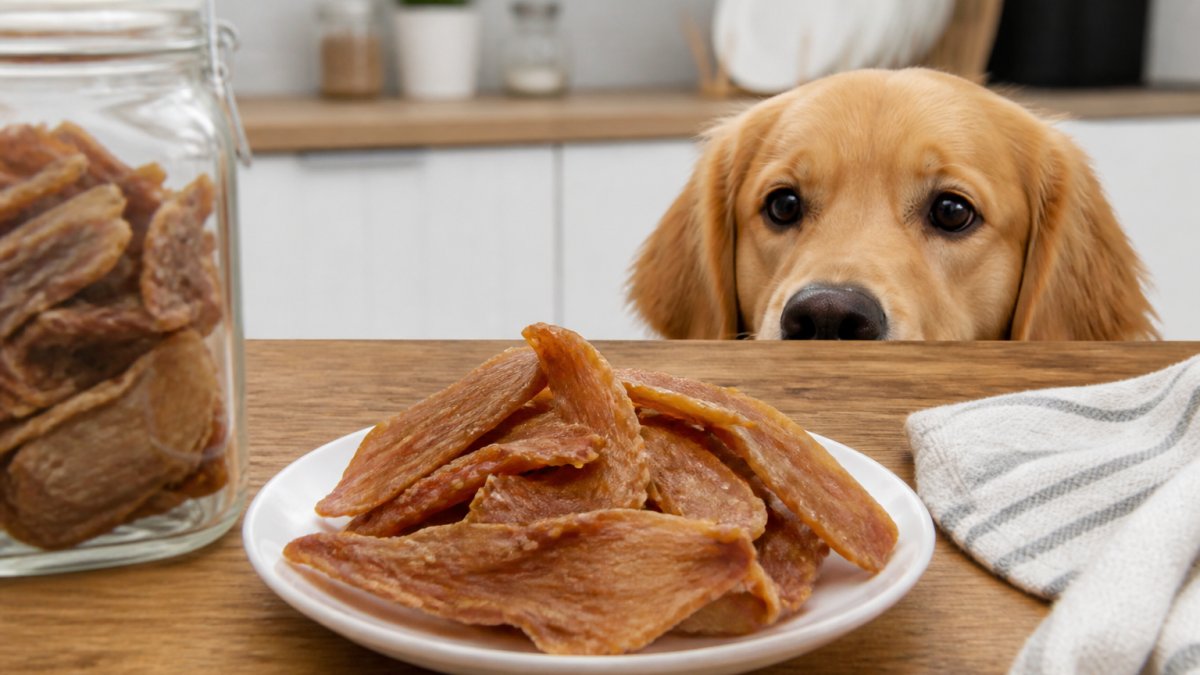
The benefits of single-ingredient dog treats come down to one word: traceability. When a treat is one ingredient, there's nothing to hide behind, you know exactly what your dog is eating and can trace it to a specific protein and source. For dogs with food sensitivities or diagnosed allergies, this matters enormously: limited-ingredient diets are the standard approach for elimination testing, and a single-ingredient treat keeps the treat variable out of the equation. Dehydrated chicken is exactly that: chicken, dehydrated, nothing else.
Palatability is the other underrated benefit. Picky dogs tend to accept single-ingredient treats more readily than heavily flavored ones, because the taste is the food itself rather than a coating. Our hand-sliced, single-ingredient dehydrated chicken treats are made in small batches with no preservatives or coatings, sourced entirely from farms in the U.S.
Labeling Loopholes That Hide Low-Quality Dog Treat Ingredients
Labeling loopholes exist because pet food regulation sets a floor, not a ceiling. The Association of American Feed Control Officials' labeling standards define what must appear on a package, but they leave significant room for interpretation. Understanding where that room is lets you read a label the way a manufacturer hopes you won't.
Ingredient splitting. Manufacturers can split one ingredient into multiple entries so no single line appears near the top. Corn can appear as corn, corn gluten meal, and corn bran, three lines, none dominant, even though corn leads by weight once combined. The same trick works with wheat (wheat, wheat middlings, wheat gluten) and sugars (sugar, corn syrup, molasses). When entries share a root ingredient, mentally add them together.
The unnamed "flavor" problem. "Natural flavor," "animal digest," and "meat flavor" are legal categories, not descriptions. They can be derived from almost any source. A manufacturer that won't name the flavor source is telling you the source isn't a selling point.
"Human-grade" without verification. This term is only meaningful if the entire product, not just one ingredient, is manufactured to federal human-food standards in an inspected facility. One human-grade ingredient in an otherwise pet-grade product doesn't make the treat human-grade. Without a facility statement or certifying body, treat the claim as aspiration, not fact.
"Premium," "gourmet," and "wholesome." None of these have a legal definition in pet food labeling. They are marketing terms with no standard behind them. A treat labeled "gourmet" is not required to be any better than one labeled "value."
Sourcing silence. A bag can say "made in the USA" while the protein inside was imported and only assembled domestically. "Made in the USA" and "sourced in the USA" are not the same claim. If a manufacturer wants you to know where the protein came from, it names a country, region, or farm. Silence on sourcing is a choice, not neutrality. Traceability is the antidote to all five loopholes: a short, named ingredient list with a stated origin is the hardest thing to fake.
Pro Tip When a label uses a term you can't verify, "premium," "human-grade," "natural flavor", check whether the manufacturer publishes sourcing details on its website. A company that can name its farms or suppliers usually does. A company that can't, won't.
Caloric Density and Nutritional Balance: What Most Owners Overlook
Caloric density is the number most owners never check, and it's the one that quietly causes problems. Treats are typically far more calorie-dense per ounce than complete dog food, so a handful of small treats can represent a significant share of a dog's daily caloric intake. For a small breed, that share can be surprisingly large.
The practical fix is straightforward: check the guaranteed analysis for calorie content per treat or per ounce, and treat calories as part of the daily total, not as a bonus on top. The World Small Animal Veterinary Association's global nutrition guidelines recommend keeping treats to a modest fraction of daily calories, which is easy to honor once you know the number.
Balance matters too. A treat high in fat and low in protein is a snack, not nutrition. A treat that's mostly protein, like dehydrated meat, contributes something meaningful.
How to Identify High Quality Dog Treat Ingredients in Practice
Identifying high quality dog treat ingredients is a repeatable process, not a judgment call. Run through these steps the next time you're holding a bag:
Flip to the ingredient list. Read the first five ingredients. Named foods only.
Scan for preservatives. BHA, BHT, ethoxyquin, propyl gallate. If present, put it back.
Check for fillers. Corn, wheat, soy, cellulose, and unnamed "meat meal."
Look for flavor enhancers. "Natural flavoring" and "animal digest" with no named source.
Read the guaranteed analysis. Note the protein percentage and calories per treat.
Count the ingredients. The shorter the list, the less there is to hide.
Check the sourcing claim. A named country or farm is a good sign. Silence is not.
Pro Tip Bring a phone and photograph the ingredient panel of any treat your dog loves. Build a small library of labels you've already vetted, so future trips to the store take two minutes instead of twenty.
Conclusion
The treat aisle is built to reward speed, and reading labels is the only defense against it. Once you know which dog treat ingredients to avoid and how to spot a vague sourcing claim, the decision gets faster, not slower.
Five Local Dogs exists for exactly this reason. Our single-ingredient dehydrated chicken treats are hand-sliced in small batches, made with no preservatives or coatings, and sourced from farms in the U.S., so the label doesn't require a decoder ring. If your dog is picky, sensitive, or just family, get started with Five Local Dogs and feed a treat you can actually trace.
Frequently Asked Questions
What are considered high quality dog treats?
High quality dog treats contain recognizable, named ingredients like dehydrated chicken, beef liver, or sweet potato. They avoid artificial preservatives, synthetic colors, and vague terms such as 'meat meal' or 'animal byproducts.' The best options list a single protein source first and include a guaranteed analysis on the package. Treats made in small batches with transparent sourcing and no chemical coatings give you the most confidence in what you're feeding your dog.
What ingredients should I avoid in dog treats?
Steer clear of treats listing BHA, BHT, ethoxyquin, propylene glycol, or artificial colors like Red 40 and Yellow 5. Watch for generic terms such as 'meat meal,' 'poultry byproduct,' and 'animal digest,' which can include low-quality rendered parts. Added sugars, corn syrup, and excessive sodium are also red flags. If the ingredient list reads like a chemistry experiment rather than a food label, put it back on the shelf.
Are single-ingredient treats better for dogs?
Single-ingredient treats offer clear advantages for dogs with food sensitivities or allergies because there's nothing to guess about. They simplify elimination diets and reduce the risk of triggering reactions from hidden additives. They also tend to be more nutritious per calorie since there are no fillers diluting the protein. For most dogs, a single-ingredient dehydrated treat works well as a training reward or everyday snack alongside a balanced diet.
How do I know if a dog treat label is misleading?
Labels can say 'natural' or 'wholesome' without strict regulatory definitions, so focus on the actual ingredient list and guaranteed analysis instead. Terms like 'meat meal' or 'animal fat' don't specify the source animal, and 'natural flavoring' can mask a range of additives. Look for named proteins, specific organs, and a clear sourcing statement. If a brand won't tell you where its ingredients come from, that silence is its own answer.
SHOP

Comments