
Buy Dehydrated Chicken Treats Online: A 2026 Buying Guide

Updated: Sep 16
Table of Contents
Why Buy Dehydrated Chicken Treats Online in 2026
The Benefits of Single Ingredient Dog Treats
How Dehydrated Chicken Treats Are Made: Dehydration Process and Moisture Content
Protein Content and Nutritional Value: What the Numbers Actually Mean
Ingredient Sourcing and Quality: How to Verify U.S.-Sourced Chicken
The Best Dog Treats for Sensitive Stomachs and Food Allergies
How to Store Dehydrated Dog Treats for Maximum Freshness
What spoilage actually looks like
Realistic shelf-life windows
The storage rules that actually move the needle
A quick freshness check before you feed
Safety and Recall History: What to Check Before You Buy
DIY vs. Store-Bought Dehydrated Chicken Treats: Cost and Convenience
The yield math nobody puts on a label
What DIY actually costs you beyond the chicken
Where store-bought wins, and where it does not
A simple way to decide
Conclusion
Frequently Asked Questions
Last Updated: September 14, 2026
Why Buy Dehydrated Chicken Treats Online in 2026
When you buy dehydrated chicken treats online, you're not just skipping a trip to the store. You're choosing a category of dog snack that has quietly become the gold standard for owners who read ingredient panels. This guide from Five Local Dogs walks through what actually separates a good bag from a bad one, so you can order with confidence instead of guesswork.
The shift toward single-ingredient, preservative-free dog snacks has been driven by owners, not marketing departments. People who feed their dogs a raw diet or a limited-ingredient diet want the same standard in their treats. Buying online opens up small-batch makers you'd never find on a big-box shelf, and it lets you check sourcing claims before you spend a dollar.
Below, we'll break down how dehydration works, what protein numbers really tell you, how to store a bag once it's open, and how to spot a maker who actually sources chicken responsibly. The five buying criteria we cover are the same ones we use when we evaluate a batch.
The Benefits of Single Ingredient Dog Treats
The core benefit of single-ingredient dog treats is simple: you know exactly what your dog is eating. One protein, nothing else. No glycerin, no smoke flavoring, no "natural flavors" hiding a dozen sub-ingredients.
That matters most for dogs with food sensitivities, where every extra additive is another variable to rule out. A limited-ingredient treat makes elimination diets workable, because you're not guessing which of eleven ingredients caused the itch.
There's a practical side too. Single-ingredient treats are easy to break into training-size pieces, they don't leave greasy residue on your fingers, and they appeal to picky eaters because the smell is pure meat rather than a coating.
Key Takeaway If your dog has ever had a reaction you couldn't trace, switching to a one-ingredient treat removes the guesswork. You can reintroduce other foods one at a time from a clean baseline.
How Dehydrated Chicken Treats Are Made: Dehydration Process and Moisture Content
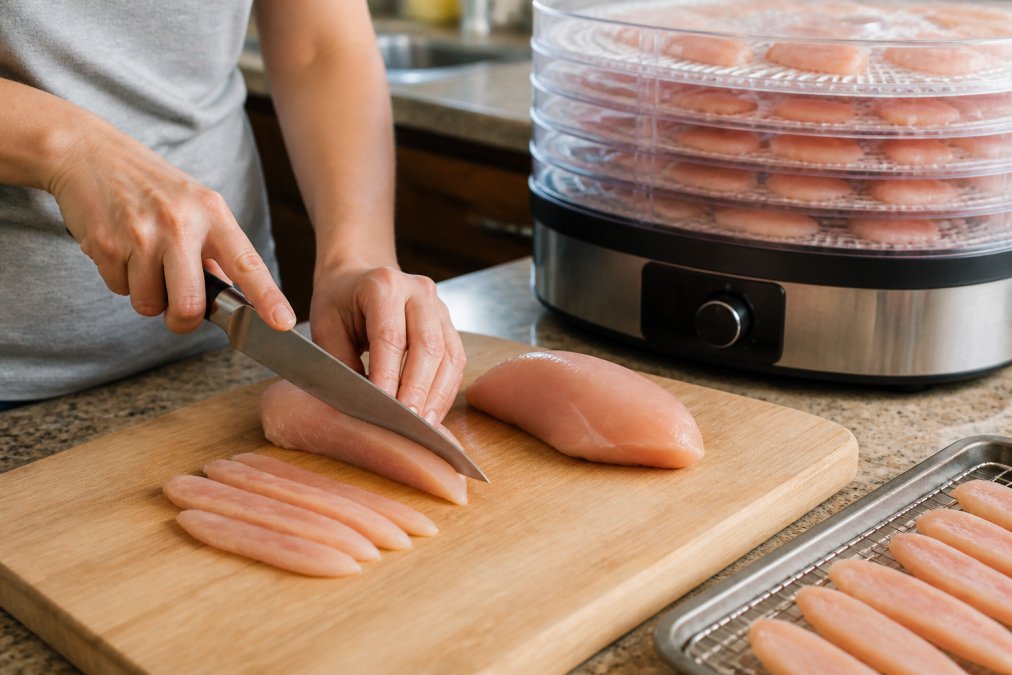
Dehydration removes water from thin-sliced chicken at low, steady heat, usually somewhere between 130°F and 160°F, until the meat is dry enough to resist spoilage without refrigeration (fsis.usda.gov). The target is a moisture content low enough that bacteria and mold can't get a foothold.
The process starts with whole-muscle chicken, not ground meat or trim. Hand-slicing matters here: uniform thickness means uniform drying, and uneven slices leave soft spots where moisture lingers. Those soft spots are where a bag goes bad early.
A well-run dehydration process preserves the protein and fat in the meat while concentrating flavor. That concentration is why dehydrated treats smell so much stronger than a baked biscuit, and why dogs who ignore everything else will still work for them.
What most guides skip is the cooling and conditioning step. After drying, the meat needs to rest so residual moisture equalizes through the slice before packaging. Skip it, and the top of the bag looks fine while the bottom goes soft.
Protein Content and Nutritional Value: What the Numbers Actually Mean
Protein content on a treat label is measured on a dry-matter basis, which means the percentage looks much higher than it would in a wet food. A dehydrated chicken treat can read as 60% to 75% protein by weight because the water is gone.
Here's what that actually means for your dog: you're feeding a concentrated protein source, so a little goes a long way. A single strip delivers more usable protein than a handful of biscuit-style treats, which are mostly filler and carbohydrates.
What to Check | Why It Matters | Red Flag |
Protein source listed first | Confirms real meat is the main ingredient | "Meat meal" or "by-product" first |
Moisture content stated | Predicts shelf stability | No moisture info at all |
Fat percentage | High fat means smaller portions | Fat % missing from label |
Ingredient count | Fewer ingredients, fewer triggers | Long additive list |
Guaranteed analysis | Backs up marketing claims | Vague "protein-rich" language |
Lean chicken is a strong choice for most dogs because it's high in protein without the fat load of beef or pork. For dogs watching their weight, that ratio is the difference between a treat that fits the daily calorie budget and one that doesn't.
Ingredient Sourcing and Quality: How to Verify U.S.-Sourced Chicken
Verifying that chicken is actually sourced domestically comes down to asking the maker directly and knowing what documentation to request. Reputable small-batch producers will tell you which farms they buy from and can share supplier documentation on request.
Start with the label. "Made in the USA" is a regulated claim about where the product was processed, not necessarily where the chicken was raised. If a maker claims domestic sourcing, ask for the specific detail: which farms, which state, and whether they buy whole muscle or trim.
The USDA Food Safety and Inspection Service labeling guidance explains how country-of-origin and "made in" claims are defined, which helps you read a label critically instead of taking it at face value.
A short supply chain is usually a good sign. When a producer can name the farms and describe how the meat is handled from delivery to slicing, that transparency is hard to fake. Vague answers about "premium suppliers" are the tell.
Pro Tip Ask a maker how long the chicken sits between delivery and dehydration. Fresh meat processed quickly tastes and smells different from meat that's been frozen and thawed repeatedly, and dogs notice the difference even when labels look identical.
The Best Dog Treats for Sensitive Stomachs and Food Allergies
The best dog treats for sensitive stomachs are single-protein, single-ingredient options with no added fats, flavorings, or preservatives. Chicken is a common protein, so if your dog has already shown a reaction to chicken, a novel protein is the better path.
If chicken is safe for your dog, a plain dehydrated chicken treat is about as low-risk as a snack gets. There's nothing to ferment, nothing artificial to react to, and the texture is easy to break into small pieces for a dog who eats too fast.
Watch portion size even with a clean ingredient list. A sensitive stomach can still react to volume, so introduce any new treat one small piece at a time over several days.
Signs to monitor when introducing a new treat:
Stool consistency over the following 24 to 48 hours
Any scratching, paw licking, or ear redness
Appetite changes at the next meal
Gas or visible discomfort after eating
If your dog has a diagnosed allergy, treat any new food as a trial and keep notes. Your veterinarian is the right person to confirm what's safe, not a label or a blog.
How to Store Dehydrated Dog Treats for Maximum Freshness
Storing dehydrated dog treats properly means keeping them dry, cool, and sealed. Moisture is the enemy, and so is heat, which can push residual fat toward rancidity. But the details matter more than the slogan, so here is what actually happens to a bag over time and how to slow it down.
What spoilage actually looks like
Two separate processes shorten a bag's life, and they fail differently:
Moisture reabsorption. Dehydrated chicken is hygroscopic, meaning it pulls water vapor out of the air. Once internal moisture climbs back above roughly 10 to 12 percent, mold and bacteria can grow again. You will usually see this first as soft, leathery slices instead of crisp ones, or a dull, cloudy look on the surface.
Fat oxidation. Chicken fat reacts with oxygen and slowly turns rancid. This is a chemical change, not a microbial one, so a rancid treat can look perfectly normal. The tell is smell: a sharp, crayon-like, or stale-oil odor instead of clean roasted chicken.
Because these fail differently, a bag can go bad in two ways, and checking only for mold misses half the problem.
Realistic shelf-life windows
Exact dates depend on the maker's moisture target, packaging, and your climate, but a common pattern is:
State | Typical window | What changes it |
Unopened, sealed with oxygen absorber | Several months to about a year | Moisture content, packaging barrier, storage temperature |
Opened, airtight container, cool pantry | Roughly 4 to 8 weeks | Humidity, how often the lid opens, slice thickness |
Opened, bag left folded but not sealed | Days to a couple of weeks | Ambient humidity, proximity to heat |
Refrigerated, sealed | Extends the opened window | Condensation risk on removal |
Frozen, sealed | Longest option | Thaw fully sealed to avoid condensation |
Treat these as planning ranges, not guarantees. A maker who publishes a moisture spec and uses a high-barrier pouch with an oxygen absorber will land at the long end; a thin zip bag in a humid kitchen lands at the short end.
The storage rules that actually move the needle
Squeeze the air out, then seal. Oxygen drives fat oxidation. Press excess air from the bag before closing, or move treats into a hard-sided airtight container that displaces air.
Keep the desiccant pack if one came with the bag. Those silica or oxygen packets are doing real work. Do not toss them until the bag is empty.
Store whole, break at feeding time. Every time you snap a slice, you expose a fresh interior surface to air. Breaking pieces as you feed them keeps the rest of the bag intact longer.
Skip the fridge door and the stove-side cabinet. Both see constant temperature swings. A steady cool pantry beats a fluctuating cold spot.
If you refrigerate, let the container reach room temperature before opening. Otherwise condensation forms directly on the meat, which is the exact moisture you spent the whole dehydration process removing.
Buy to your feeding rate, not to the discount. A bulk bag only saves money if you finish it inside its window. Smaller, more frequent orders beat a large bag that sits half-open for months.
Watch Out Never store dehydrated treats in the refrigerator door or next to the stove. Temperature swings and ambient moisture are the two fastest ways to turn a crisp treat soft and moldy, and moldy meat treats are a genuine health risk.
A quick freshness check before you feed
Before offering a treat from an older bag, run three checks: it should snap rather than bend, it should smell like roasted chicken rather than stale oil, and it should show no fuzzy or discolored patches. If any check fails, throw the bag out. There is no safe way to re-dry a treat that has already taken on moisture at home, because home ovens cannot reliably hit the low, even temperatures a commercial dehydrator uses without cooking the outside and leaving the inside damp.
Safety and Recall History: What to Check Before You Buy
Checking recall history before you buy is one of the most overlooked steps in choosing a dog treat. The FDA's recall and market withdrawal database lets you search by product, brand, or contaminant, and it's free to use.
Most treat recalls trace back to one of a few causes: Salmonella contamination, foreign material, or a labeling error that hides an allergen. Small-batch producers with tight controls have fewer of these events, but no maker is immune, which is why checking is worth two minutes.
Beyond recalls, look for how a maker handles a problem. A producer who publishes a clear response when something goes wrong is more trustworthy than one whose website never mentions quality control at all.
Questions worth asking any maker before you order:
Do you test finished batches, and how often?
What's your process if a batch fails a check?
Can you share your most recent test results?
How do you handle a customer report of a foreign object?
DIY vs. Store-Bought Dehydrated Chicken Treats: Cost and Convenience
Making dehydrated chicken treats at home is genuinely doable, and it gives you total control over sourcing. You buy chicken, slice it thin, run a dehydrator for several hours, and store the result. The trade-off is time and consistency, and the honest way to compare the two paths is to look at yield, not sticker price.
The yield math nobody puts on a label
Raw chicken breast is roughly 70 to 75 percent water. Dehydration drives most of that off, so a batch shrinks dramatically. A common pattern is that you end up with somewhere in the range of a quarter to a third of the raw weight once the meat is fully dry. That single fact reframes the whole comparison:
If you start with a pound of raw breast, expect a finished yield in the low single-digit ounces, not a pound.
The cost per finished ounce of DIY treats is therefore several times the per-pound price you paid at the meat counter.
Store-bought treats are priced on finished weight, so the two numbers are not directly comparable until you convert the DIY batch to its dried yield.
Run that conversion once with your own local chicken price and your own dehydrator's results, and the gap between DIY and store-bought usually narrows far more than people expect. DIY still tends to win on cost per ounce for heavy feeders, but the margin is smaller than the raw-weight comparison suggests.
What DIY actually costs you beyond the chicken
Equipment. A countertop dehydrator is a one-time purchase, but it only pays for itself across many batches. Occasional treat-makers rarely break even.
Time. Slicing, loading trays, and a multi-hour dry cycle add up. Most of that is passive, but you still have to be home to start and finish it.
Electricity. A dehydrator running for hours draws real power, and that cost scales with every batch.
Waste. Uneven hand-slicing means some pieces dry faster than others. Over-dried pieces crumble; under-dried pieces have to be discarded or re-run.
Food-safety burden. You are handling raw poultry and taking on the responsibility for getting the meat dry enough to be shelf-stable. That is the same job a commercial producer does under inspection.
Where store-bought wins, and where it does not
Buying from a small-batch maker trades effort for consistency. You get uniform slices, verified sourcing, and a documented process, which matters if your dog has a sensitive stomach and you need repeatable results. The trade-off is that you pay for someone else's labor, equipment, and quality control, and you are trusting their sourcing claims rather than controlling them yourself.
Factor | DIY | Store-Bought |
Upfront cost | Dehydrator purchase | None |
Cost per finished ounce | Lower at scale, higher for occasional batches | Fixed and predictable |
Time per batch | Several hours active and passive | None |
Consistency | Varies by slice and machine | Uniform by design |
Sourcing control | Total | Depends on maker transparency |
Food-safety burden | On you | On the producer |
Best for | Hands-on owners, bulk feeders | Busy owners, sensitive dogs |
A simple way to decide
If you feed treats daily to a large dog or a multi-dog household, DIY can genuinely save money once your equipment is paid off, and you get full control over sourcing. If you feed a small dog occasionally, or you need identical results batch after batch because your dog has a sensitive stomach, buying is the better call. The break-even point is not about the price of chicken. It is about how many finished ounces you actually go through in a month, and whether you want to spend your evenings managing trays.
Conclusion
Choosing the right bag comes down to reading labels critically, asking makers direct questions, and storing what you buy correctly. Five Local Dogs makes that decision easier with single-ingredient dehydrated chicken treats that are hand-sliced in small batches, free from preservatives and artificial coatings, and sourced from farms in the U.S. If you want a treat you can trace back to its source and feel good about feeding, Five Local Dogs is built for exactly that. Shop the current batch and see the difference fresh, consistent quality makes for your dog.
Frequently Asked Questions
Are dehydrated chicken treats safe for dogs?
Yes, dehydrated chicken treats are safe for most dogs when made from human-grade meat and processed properly. The dehydration process removes moisture, which prevents bacterial growth and makes the treats shelf-stable without preservatives. Look for treats that are single-ingredient and free from artificial coatings or additives. Always introduce new treats gradually, especially if your dog has a sensitive stomach, and check with your vet if your dog has underlying health conditions.
What are the benefits of single-ingredient dog treats?
Single-ingredient dog treats contain no fillers, preservatives, or artificial additives, which makes them easier to digest and less likely to trigger allergic reactions. They are ideal for dogs with food sensitivities because you know exactly what you are feeding. Dehydrated chicken treats also provide lean protein, support muscle maintenance, and work well as high-value training rewards. For picky dogs, the concentrated chicken flavor and crunchy texture often make them more appealing than processed alternatives.
How do I know if dog treats contain artificial preservatives?
Check the ingredient list on the packaging. If you see items like BHA, BHT, ethoxyquin, propylene glycol, or artificial colors, the product contains synthetic additives. Single-ingredient treats should list only the protein source, such as chicken. Dehydrated treats are naturally preserved through moisture removal, so they do not need chemical preservatives. When buying online, look for brands that publish full ingredient lists and sourcing details on their product pages.
How long do dehydrated chicken treats stay fresh after opening?
Most dehydrated chicken treats stay fresh for two to four weeks after opening if stored properly. Keep them in an airtight container in a cool, dry place away from direct sunlight. Refrigeration can extend freshness further, especially in humid climates. If the treats become soft, smell off, or develop mold, discard them. Buying in smaller quantities or from brands that hand-slice in small batches helps ensure you receive the freshest product possible.
SHOP

Comments